Drappier Cuvée Charles de Gaulle Brut Champagne NV 750ml
In the 1960s, when General Charles de Gaulle was not at the Élysée Palace or on official business, he retired to La Boisserie — his private residence in Colombey-les-Deux-Églises, the village in the hills of the Haute-Marne where he had lived with his family since the 1930s and where he would eventually be buried. He writes about those hills in his memoirs with the specific love of a man who understands that the land one comes from is inseparable from the character one becomes. In the hills around La Boisserie, within a few kilometers of Urville, Champagne Drappier had been producing wines since 1808. His aide-de-camp, Colonel de Bonneval, was already a loyal Drappier customer. Through him, the General discovered it.
He chose a cuvée rich in Pinot Noir — 80% Pinot Noir, specifically, the grape that Drappier had planted and championed in the Aube when the conventional wisdom of the Champagne establishment said it did not belong there, and that the Drappier house's history had proved to be the most specifically Aube-appropriate and the most specifically characterful of all Champagne's varieties. For his private receptions at La Boisserie, he served it. He liked, as the official Drappier account specifies, "to savor an aromatic and authentic Champagne." The cuvée was reissued in his honor. In 1990, on the 50th anniversary of the Appeal of June 18th — de Gaulle's wartime broadcast from London calling France to resistance — the Cuvée Charles de Gaulle was formally launched.
The cuvée pays tribute to this great man, with a Champagne of character, whose strength and authenticity are revealed in their most beautiful expression. The juices are partially aged in wood. Bottle aging for 36 months. Dosage 7 g/L. Forward with ripe aromas of cherry liqueur, saline, and fresh flowers. Medium to full-bodied, powerful and assertive on the palate, with wonderful fruit intensity and a long, pure finish. Remarkable complexity, an airy mousse, and slightly candied notes. The Champagne of the man who saved France, served now at Blackwell's.
Origins & Craftsmanship
Champagne Drappier was founded in 1808 in Urville, in the Côte des Bar sub-region of the Aube — the southernmost of Champagne's sub-regions, whose Kimmeridgian clay-limestone soils and warmer microclimate produce Pinot Noir of exceptional concentration and aromatic power. The house operates from a 12th-century cellar originally built by Cistercian monks and has maintained, across eight generations of the Drappier family, an uncompromising commitment to Pinot Noir as the appellation's most characterful and most specifically Aube-appropriate variety.
Since its creation in 1808, the Champagne Drappier House has a history intimately linked to Pinot Noir, its grape of choice. It was in the 1930s that, against the general opinion of the community, this grape variety was replanted on the estate. History proved the House right.
The Cuvée Charles de Gaulle is the most directly Pinot Noir-expressive expression in the Drappier range — 80% Pinot Noir from the Aube's Kimmeridgian limestone vineyards, with 20% Chardonnay added for elegance and persistent freshness. Only juices from the first press — the cuvées — are used. Low-pressure mechanical presses. Gravity is used to avoid pumping, which prevents oxidation. Minimal use of sulfur. Natural settling. Alcoholic fermentation for around 2 weeks at low temperature. Then natural and complete malolactic fermentation. No filtration. After bottling, the cuvée is matured for at least 3 years on laths. A portion of the wine is partially aged in oak — adding the specific broad mid-palate richness and the subtle wood-adjacent complexity that distinguishes the Charles de Gaulle from Drappier's stainless-steel-only expressions. Dosage 7 g/L — Brut territory. Disgorged July 2025 in the most recent release.
Critics Reviews
"A fresh and expressive Champagne, featuring lively green apple, cherry, tea rose and toast notes. Well-balanced, with hints of chalk and spice lingering on the finish." Wine Spectator 91 Points
". . . bursting from the glass with a generous bouquet of golden orchard fruits, warm biscuits, honeycomb and peach. On the palate, it's full-bodied, rich and enveloping, with a fleshy core of fruit and nicely integrated dosage that lends the wine an old-fashioned, gourmand profile that's appropriate enough given its namesake. I'd expect this to pick up considerable toasty complexity with additional aging on cork." Robert Parker 92 Points
Tasting Profile
Nose
Yellow gold with fine, persistent bubbles — the 80% Pinot Noir and the partial oak aging producing a color of warm depth, richer than a standard Blanc de Blancs. The nose opens with the character that the Wine Advocate's most recent tasting confirmed most specifically: ripe aromas of cherry liqueur lead with the vivid, slightly concentrated red fruit intensity that Pinot Noir-dominant Champagne from the Aube's warmer microclimate produces most specifically. Saline adds a mineral coastal freshness. Fresh flowers add delicate floral lift. Citrus fruits follow with bright secondary energy — lemon and citrus zest adding the Chardonnay's most direct contribution to the nose. Apple adds the most classically Champagne-method secondary fruit note. Almond and nutmeg add the most warm and the most specifically oak-adjacent secondary aromatics — the partial wood aging's most delicate contribution. Fresh walnut accents and biscuit add further complexity from the 36-month lath aging. Dried fruits add depth. The nose is generous, forward, and aromatic in the way that the best Aube Pinot Noir Champagne produces most specifically — more vinous, more forward, and more specifically fruit-expressive than the more restrained Montagne de Reims style.
Palate
Medium to full-bodied, powerful, and assertive — the Wine Advocate's most accurate palate characterization confirmed from the first sip. This is not a delicate, restrained Champagne. It is a Champagne of character, as Drappier specifically and specifically intentionally frames it — the 80% Aube Pinot Noir's warmth and vinosity most fully expressed at its broadest and most powerful. Remarkable complexity from the first moment. An airy mousse — fine-bubbled, refined, and elegant despite the Pinot Noir's considerable palate weight. Ripe pip and stone fruits — white peach carrying through from the Wood-aged component — complemented by lively acidity and minerality from the Kimmeridgian limestone terroir. Slightly candied notes add the most approachable and the most broadly appealing secondary sweetness. The broad mid-palate attributed specifically to the partial oak aging is most apparent here — a richness and density that stainless-steel-only vinification cannot produce at this Pinot Noir concentration. Wonderful fruit intensity carries the core of the palate throughout.
Finish
Long, pure, warm, and balanced. The Wine Advocate's "long, pure finish" and "warmth on the finish that remains balanced" are the most specifically accurate and the most completely confirmed finish characterizations — the Pinot Noir's considerable presence at the close is warm, sustained, and entirely harmonious rather than aggressive. Candied fruit notes persist. The finesse of the bubbles persists in the length of an elegant, airy close. The Drink 2024-2044 window confirmed in a finish of genuine cellaring promise.
Quick Overview
| Category | Details |
|---|---|
| Appellation | Champagne — Côte des Bar · Aube |
| Style | Brut NV — Pinot Noir-Dominant |
| Blend | 80% Pinot Noir · 20% Chardonnay |
| Pressing | First press only — cuvées fractions |
| Pressing Method | Low-pressure mechanical presses |
| Vinification | Gravity only — no pumping · no oxidation |
| Malolactic | Complete and natural |
| Oak | Partial — adds broad mid-palate richness |
| Filtration | None |
| Sulfur | Minimal — Drappier house commitment |
| Lath Aging | Minimum 36 months |
| Dosage | 7 g/L — Brut |
| Most Recent Disgorgement | July 2025 |
| Drinking Window | 2024–2044 |
| House | Champagne Drappier — Urville, Aube · founded 1808 |
| Cuvée Created | 1990 — 50th anniversary of the Appeal of June 18th |
| Historical Connection | General de Gaulle's personal Champagne for private receptions at La Boisserie |
| How de Gaulle Discovered | Through aide-de-camp Colonel de Bonneval, a loyal Drappier customer |
| De Gaulle's Preference | "Aromatic and authentic Champagne" — especially the 100% Pinot Noir cuvée for family meals |
| Aube Pinot Noir Pioneer | Drappier replanted Pinot Noir in the 1930s against conventional Champagne wisdom |
| Style / Identity | Powerful, vinous, characterful Pinot Noir Champagne — aromatic, assertive, refined |
| Aromas & Flavors | Cherry liqueur, saline, fresh flowers, citrus, apple, almond, nutmeg, walnut, biscuit, dried fruit, white peach, candied fruit, minerality |
| Bottle Size | 750ml |
Food Pairings
The 80% Pinot Noir weight and the partial oak richness make the Charles de Gaulle the most food-serious and the most specifically poultry and game-aligned Champagne in the Blackwell's section — reflecting exactly the foods de Gaulle served it alongside at La Boisserie:
- Pheasant hen stuffed with foie gras — the official Drappier recommendation and the most specifically de Gaulle-era pairing
- Mesclun salad with grilled guinea fowl skewers
- Roasted chicken and poultry preparations
- Brie de Meaux — the most specifically Champagne-region cheese pairing
- Crayfish and lobster — the saline quality aligning with shellfish
- Charcuterie at aperitif
- Barbecued whole fish
Product Information
Product Information
Shipping & Returns
Shipping & Returns
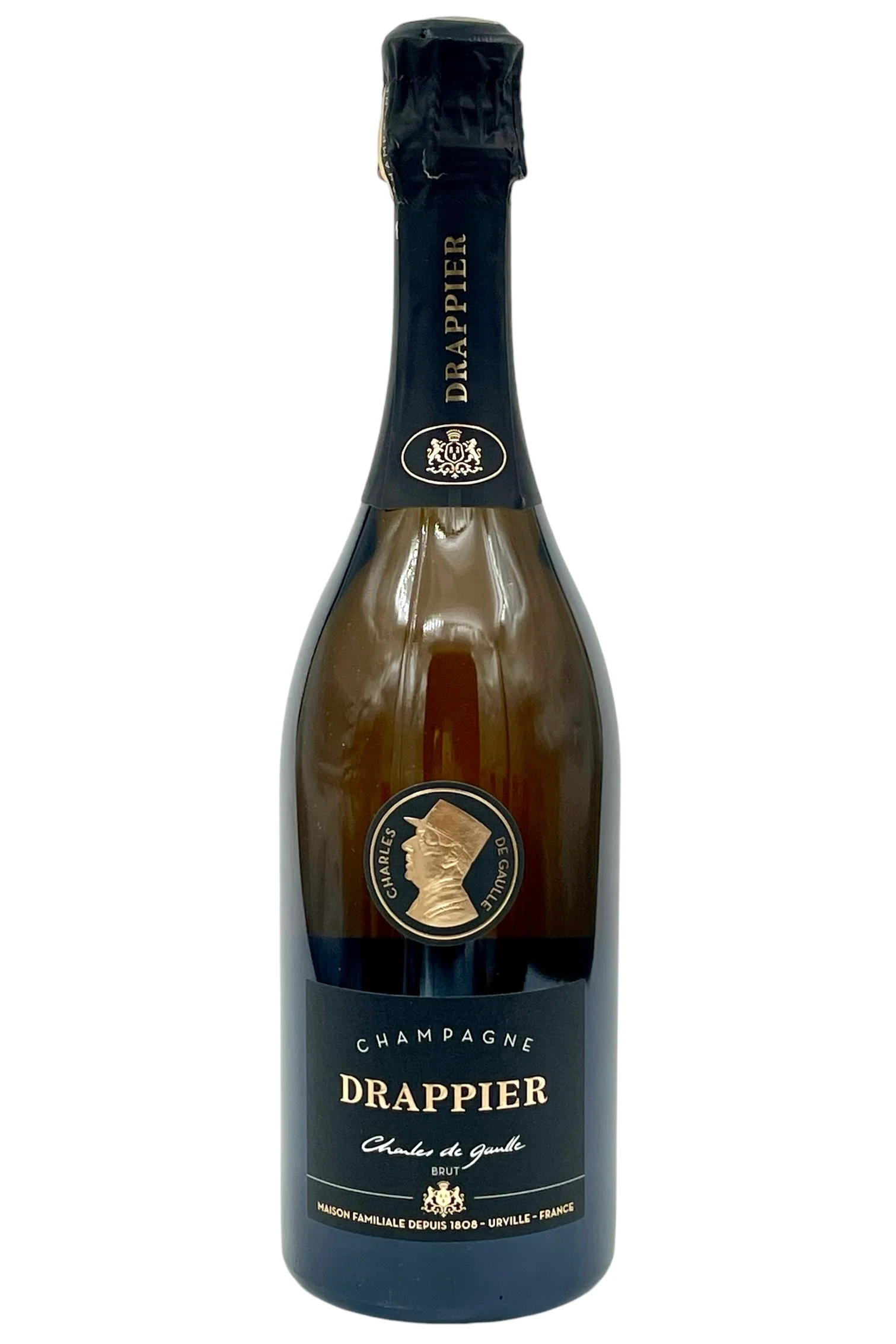
Drappier Cuvée Charles de Gaulle Brut Champagne NV 750ml
Drappier Cuvée Charles de Gaulle Brut Champagne NV 750ml
In the 1960s, when General Charles de Gaulle was not at the Élysée Palace or on official business, he retired to La Boisserie — his private residence in Colombey-les-Deux-Églises, the village in the hills of the Haute-Marne where he had lived with his family since the 1930s and where he would eventually be buried. He writes about those hills in his memoirs with the specific love of a man who understands that the land one comes from is inseparable from the character one becomes. In the hills around La Boisserie, within a few kilometers of Urville, Champagne Drappier had been producing wines since 1808. His aide-de-camp, Colonel de Bonneval, was already a loyal Drappier customer. Through him, the General discovered it.
He chose a cuvée rich in Pinot Noir — 80% Pinot Noir, specifically, the grape that Drappier had planted and championed in the Aube when the conventional wisdom of the Champagne establishment said it did not belong there, and that the Drappier house's history had proved to be the most specifically Aube-appropriate and the most specifically characterful of all Champagne's varieties. For his private receptions at La Boisserie, he served it. He liked, as the official Drappier account specifies, "to savor an aromatic and authentic Champagne." The cuvée was reissued in his honor. In 1990, on the 50th anniversary of the Appeal of June 18th — de Gaulle's wartime broadcast from London calling France to resistance — the Cuvée Charles de Gaulle was formally launched.
The cuvée pays tribute to this great man, with a Champagne of character, whose strength and authenticity are revealed in their most beautiful expression. The juices are partially aged in wood. Bottle aging for 36 months. Dosage 7 g/L. Forward with ripe aromas of cherry liqueur, saline, and fresh flowers. Medium to full-bodied, powerful and assertive on the palate, with wonderful fruit intensity and a long, pure finish. Remarkable complexity, an airy mousse, and slightly candied notes. The Champagne of the man who saved France, served now at Blackwell's.
Origins & Craftsmanship
Champagne Drappier was founded in 1808 in Urville, in the Côte des Bar sub-region of the Aube — the southernmost of Champagne's sub-regions, whose Kimmeridgian clay-limestone soils and warmer microclimate produce Pinot Noir of exceptional concentration and aromatic power. The house operates from a 12th-century cellar originally built by Cistercian monks and has maintained, across eight generations of the Drappier family, an uncompromising commitment to Pinot Noir as the appellation's most characterful and most specifically Aube-appropriate variety.
Since its creation in 1808, the Champagne Drappier House has a history intimately linked to Pinot Noir, its grape of choice. It was in the 1930s that, against the general opinion of the community, this grape variety was replanted on the estate. History proved the House right.
The Cuvée Charles de Gaulle is the most directly Pinot Noir-expressive expression in the Drappier range — 80% Pinot Noir from the Aube's Kimmeridgian limestone vineyards, with 20% Chardonnay added for elegance and persistent freshness. Only juices from the first press — the cuvées — are used. Low-pressure mechanical presses. Gravity is used to avoid pumping, which prevents oxidation. Minimal use of sulfur. Natural settling. Alcoholic fermentation for around 2 weeks at low temperature. Then natural and complete malolactic fermentation. No filtration. After bottling, the cuvée is matured for at least 3 years on laths. A portion of the wine is partially aged in oak — adding the specific broad mid-palate richness and the subtle wood-adjacent complexity that distinguishes the Charles de Gaulle from Drappier's stainless-steel-only expressions. Dosage 7 g/L — Brut territory. Disgorged July 2025 in the most recent release.
Critics Reviews
"A fresh and expressive Champagne, featuring lively green apple, cherry, tea rose and toast notes. Well-balanced, with hints of chalk and spice lingering on the finish." Wine Spectator 91 Points
". . . bursting from the glass with a generous bouquet of golden orchard fruits, warm biscuits, honeycomb and peach. On the palate, it's full-bodied, rich and enveloping, with a fleshy core of fruit and nicely integrated dosage that lends the wine an old-fashioned, gourmand profile that's appropriate enough given its namesake. I'd expect this to pick up considerable toasty complexity with additional aging on cork." Robert Parker 92 Points
Tasting Profile
Nose
Yellow gold with fine, persistent bubbles — the 80% Pinot Noir and the partial oak aging producing a color of warm depth, richer than a standard Blanc de Blancs. The nose opens with the character that the Wine Advocate's most recent tasting confirmed most specifically: ripe aromas of cherry liqueur lead with the vivid, slightly concentrated red fruit intensity that Pinot Noir-dominant Champagne from the Aube's warmer microclimate produces most specifically. Saline adds a mineral coastal freshness. Fresh flowers add delicate floral lift. Citrus fruits follow with bright secondary energy — lemon and citrus zest adding the Chardonnay's most direct contribution to the nose. Apple adds the most classically Champagne-method secondary fruit note. Almond and nutmeg add the most warm and the most specifically oak-adjacent secondary aromatics — the partial wood aging's most delicate contribution. Fresh walnut accents and biscuit add further complexity from the 36-month lath aging. Dried fruits add depth. The nose is generous, forward, and aromatic in the way that the best Aube Pinot Noir Champagne produces most specifically — more vinous, more forward, and more specifically fruit-expressive than the more restrained Montagne de Reims style.
Palate
Medium to full-bodied, powerful, and assertive — the Wine Advocate's most accurate palate characterization confirmed from the first sip. This is not a delicate, restrained Champagne. It is a Champagne of character, as Drappier specifically and specifically intentionally frames it — the 80% Aube Pinot Noir's warmth and vinosity most fully expressed at its broadest and most powerful. Remarkable complexity from the first moment. An airy mousse — fine-bubbled, refined, and elegant despite the Pinot Noir's considerable palate weight. Ripe pip and stone fruits — white peach carrying through from the Wood-aged component — complemented by lively acidity and minerality from the Kimmeridgian limestone terroir. Slightly candied notes add the most approachable and the most broadly appealing secondary sweetness. The broad mid-palate attributed specifically to the partial oak aging is most apparent here — a richness and density that stainless-steel-only vinification cannot produce at this Pinot Noir concentration. Wonderful fruit intensity carries the core of the palate throughout.
Finish
Long, pure, warm, and balanced. The Wine Advocate's "long, pure finish" and "warmth on the finish that remains balanced" are the most specifically accurate and the most completely confirmed finish characterizations — the Pinot Noir's considerable presence at the close is warm, sustained, and entirely harmonious rather than aggressive. Candied fruit notes persist. The finesse of the bubbles persists in the length of an elegant, airy close. The Drink 2024-2044 window confirmed in a finish of genuine cellaring promise.
Quick Overview
| Category | Details |
|---|---|
| Appellation | Champagne — Côte des Bar · Aube |
| Style | Brut NV — Pinot Noir-Dominant |
| Blend | 80% Pinot Noir · 20% Chardonnay |
| Pressing | First press only — cuvées fractions |
| Pressing Method | Low-pressure mechanical presses |
| Vinification | Gravity only — no pumping · no oxidation |
| Malolactic | Complete and natural |
| Oak | Partial — adds broad mid-palate richness |
| Filtration | None |
| Sulfur | Minimal — Drappier house commitment |
| Lath Aging | Minimum 36 months |
| Dosage | 7 g/L — Brut |
| Most Recent Disgorgement | July 2025 |
| Drinking Window | 2024–2044 |
| House | Champagne Drappier — Urville, Aube · founded 1808 |
| Cuvée Created | 1990 — 50th anniversary of the Appeal of June 18th |
| Historical Connection | General de Gaulle's personal Champagne for private receptions at La Boisserie |
| How de Gaulle Discovered | Through aide-de-camp Colonel de Bonneval, a loyal Drappier customer |
| De Gaulle's Preference | "Aromatic and authentic Champagne" — especially the 100% Pinot Noir cuvée for family meals |
| Aube Pinot Noir Pioneer | Drappier replanted Pinot Noir in the 1930s against conventional Champagne wisdom |
| Style / Identity | Powerful, vinous, characterful Pinot Noir Champagne — aromatic, assertive, refined |
| Aromas & Flavors | Cherry liqueur, saline, fresh flowers, citrus, apple, almond, nutmeg, walnut, biscuit, dried fruit, white peach, candied fruit, minerality |
| Bottle Size | 750ml |
Food Pairings
The 80% Pinot Noir weight and the partial oak richness make the Charles de Gaulle the most food-serious and the most specifically poultry and game-aligned Champagne in the Blackwell's section — reflecting exactly the foods de Gaulle served it alongside at La Boisserie:
- Pheasant hen stuffed with foie gras — the official Drappier recommendation and the most specifically de Gaulle-era pairing
- Mesclun salad with grilled guinea fowl skewers
- Roasted chicken and poultry preparations
- Brie de Meaux — the most specifically Champagne-region cheese pairing
- Crayfish and lobster — the saline quality aligning with shellfish
- Charcuterie at aperitif
- Barbecued whole fish
Product Information
Product Information
Shipping & Returns
Shipping & Returns
Description
In the 1960s, when General Charles de Gaulle was not at the Élysée Palace or on official business, he retired to La Boisserie — his private residence in Colombey-les-Deux-Églises, the village in the hills of the Haute-Marne where he had lived with his family since the 1930s and where he would eventually be buried. He writes about those hills in his memoirs with the specific love of a man who understands that the land one comes from is inseparable from the character one becomes. In the hills around La Boisserie, within a few kilometers of Urville, Champagne Drappier had been producing wines since 1808. His aide-de-camp, Colonel de Bonneval, was already a loyal Drappier customer. Through him, the General discovered it.
He chose a cuvée rich in Pinot Noir — 80% Pinot Noir, specifically, the grape that Drappier had planted and championed in the Aube when the conventional wisdom of the Champagne establishment said it did not belong there, and that the Drappier house's history had proved to be the most specifically Aube-appropriate and the most specifically characterful of all Champagne's varieties. For his private receptions at La Boisserie, he served it. He liked, as the official Drappier account specifies, "to savor an aromatic and authentic Champagne." The cuvée was reissued in his honor. In 1990, on the 50th anniversary of the Appeal of June 18th — de Gaulle's wartime broadcast from London calling France to resistance — the Cuvée Charles de Gaulle was formally launched.
The cuvée pays tribute to this great man, with a Champagne of character, whose strength and authenticity are revealed in their most beautiful expression. The juices are partially aged in wood. Bottle aging for 36 months. Dosage 7 g/L. Forward with ripe aromas of cherry liqueur, saline, and fresh flowers. Medium to full-bodied, powerful and assertive on the palate, with wonderful fruit intensity and a long, pure finish. Remarkable complexity, an airy mousse, and slightly candied notes. The Champagne of the man who saved France, served now at Blackwell's.
Origins & Craftsmanship
Champagne Drappier was founded in 1808 in Urville, in the Côte des Bar sub-region of the Aube — the southernmost of Champagne's sub-regions, whose Kimmeridgian clay-limestone soils and warmer microclimate produce Pinot Noir of exceptional concentration and aromatic power. The house operates from a 12th-century cellar originally built by Cistercian monks and has maintained, across eight generations of the Drappier family, an uncompromising commitment to Pinot Noir as the appellation's most characterful and most specifically Aube-appropriate variety.
Since its creation in 1808, the Champagne Drappier House has a history intimately linked to Pinot Noir, its grape of choice. It was in the 1930s that, against the general opinion of the community, this grape variety was replanted on the estate. History proved the House right.
The Cuvée Charles de Gaulle is the most directly Pinot Noir-expressive expression in the Drappier range — 80% Pinot Noir from the Aube's Kimmeridgian limestone vineyards, with 20% Chardonnay added for elegance and persistent freshness. Only juices from the first press — the cuvées — are used. Low-pressure mechanical presses. Gravity is used to avoid pumping, which prevents oxidation. Minimal use of sulfur. Natural settling. Alcoholic fermentation for around 2 weeks at low temperature. Then natural and complete malolactic fermentation. No filtration. After bottling, the cuvée is matured for at least 3 years on laths. A portion of the wine is partially aged in oak — adding the specific broad mid-palate richness and the subtle wood-adjacent complexity that distinguishes the Charles de Gaulle from Drappier's stainless-steel-only expressions. Dosage 7 g/L — Brut territory. Disgorged July 2025 in the most recent release.
Critics Reviews
"A fresh and expressive Champagne, featuring lively green apple, cherry, tea rose and toast notes. Well-balanced, with hints of chalk and spice lingering on the finish." Wine Spectator 91 Points
". . . bursting from the glass with a generous bouquet of golden orchard fruits, warm biscuits, honeycomb and peach. On the palate, it's full-bodied, rich and enveloping, with a fleshy core of fruit and nicely integrated dosage that lends the wine an old-fashioned, gourmand profile that's appropriate enough given its namesake. I'd expect this to pick up considerable toasty complexity with additional aging on cork." Robert Parker 92 Points
Tasting Profile
Nose
Yellow gold with fine, persistent bubbles — the 80% Pinot Noir and the partial oak aging producing a color of warm depth, richer than a standard Blanc de Blancs. The nose opens with the character that the Wine Advocate's most recent tasting confirmed most specifically: ripe aromas of cherry liqueur lead with the vivid, slightly concentrated red fruit intensity that Pinot Noir-dominant Champagne from the Aube's warmer microclimate produces most specifically. Saline adds a mineral coastal freshness. Fresh flowers add delicate floral lift. Citrus fruits follow with bright secondary energy — lemon and citrus zest adding the Chardonnay's most direct contribution to the nose. Apple adds the most classically Champagne-method secondary fruit note. Almond and nutmeg add the most warm and the most specifically oak-adjacent secondary aromatics — the partial wood aging's most delicate contribution. Fresh walnut accents and biscuit add further complexity from the 36-month lath aging. Dried fruits add depth. The nose is generous, forward, and aromatic in the way that the best Aube Pinot Noir Champagne produces most specifically — more vinous, more forward, and more specifically fruit-expressive than the more restrained Montagne de Reims style.
Palate
Medium to full-bodied, powerful, and assertive — the Wine Advocate's most accurate palate characterization confirmed from the first sip. This is not a delicate, restrained Champagne. It is a Champagne of character, as Drappier specifically and specifically intentionally frames it — the 80% Aube Pinot Noir's warmth and vinosity most fully expressed at its broadest and most powerful. Remarkable complexity from the first moment. An airy mousse — fine-bubbled, refined, and elegant despite the Pinot Noir's considerable palate weight. Ripe pip and stone fruits — white peach carrying through from the Wood-aged component — complemented by lively acidity and minerality from the Kimmeridgian limestone terroir. Slightly candied notes add the most approachable and the most broadly appealing secondary sweetness. The broad mid-palate attributed specifically to the partial oak aging is most apparent here — a richness and density that stainless-steel-only vinification cannot produce at this Pinot Noir concentration. Wonderful fruit intensity carries the core of the palate throughout.
Finish
Long, pure, warm, and balanced. The Wine Advocate's "long, pure finish" and "warmth on the finish that remains balanced" are the most specifically accurate and the most completely confirmed finish characterizations — the Pinot Noir's considerable presence at the close is warm, sustained, and entirely harmonious rather than aggressive. Candied fruit notes persist. The finesse of the bubbles persists in the length of an elegant, airy close. The Drink 2024-2044 window confirmed in a finish of genuine cellaring promise.
Quick Overview
| Category | Details |
|---|---|
| Appellation | Champagne — Côte des Bar · Aube |
| Style | Brut NV — Pinot Noir-Dominant |
| Blend | 80% Pinot Noir · 20% Chardonnay |
| Pressing | First press only — cuvées fractions |
| Pressing Method | Low-pressure mechanical presses |
| Vinification | Gravity only — no pumping · no oxidation |
| Malolactic | Complete and natural |
| Oak | Partial — adds broad mid-palate richness |
| Filtration | None |
| Sulfur | Minimal — Drappier house commitment |
| Lath Aging | Minimum 36 months |
| Dosage | 7 g/L — Brut |
| Most Recent Disgorgement | July 2025 |
| Drinking Window | 2024–2044 |
| House | Champagne Drappier — Urville, Aube · founded 1808 |
| Cuvée Created | 1990 — 50th anniversary of the Appeal of June 18th |
| Historical Connection | General de Gaulle's personal Champagne for private receptions at La Boisserie |
| How de Gaulle Discovered | Through aide-de-camp Colonel de Bonneval, a loyal Drappier customer |
| De Gaulle's Preference | "Aromatic and authentic Champagne" — especially the 100% Pinot Noir cuvée for family meals |
| Aube Pinot Noir Pioneer | Drappier replanted Pinot Noir in the 1930s against conventional Champagne wisdom |
| Style / Identity | Powerful, vinous, characterful Pinot Noir Champagne — aromatic, assertive, refined |
| Aromas & Flavors | Cherry liqueur, saline, fresh flowers, citrus, apple, almond, nutmeg, walnut, biscuit, dried fruit, white peach, candied fruit, minerality |
| Bottle Size | 750ml |
Food Pairings
The 80% Pinot Noir weight and the partial oak richness make the Charles de Gaulle the most food-serious and the most specifically poultry and game-aligned Champagne in the Blackwell's section — reflecting exactly the foods de Gaulle served it alongside at La Boisserie:
- Pheasant hen stuffed with foie gras — the official Drappier recommendation and the most specifically de Gaulle-era pairing
- Mesclun salad with grilled guinea fowl skewers
- Roasted chicken and poultry preparations
- Brie de Meaux — the most specifically Champagne-region cheese pairing
- Crayfish and lobster — the saline quality aligning with shellfish
- Charcuterie at aperitif
- Barbecued whole fish